
This is something that has bugged me for a while now, and I honestly just don’t get it.
Back in 2021, the Environment Agency (EA) in the UK published new guidance for the industry, specifically targeting events and event organizers, to reduce plastic usage. A significant number of organisers have stepped up to this challenge, changing the way they deliver their events. This includes implementing virtual goodie bags, forgoing medals or switching to wooden medals, reducing waste at feed stations, and providing reusable cups for water.

Why Does This Matter?
Here are some facts from the EA’s guidance:
- Around 12 million tonnes of plastic enter our environment each year.
- Of all plastic produced, 50% is for single-use items, which are used for only a few minutes before being discarded.
- It is estimated that major sporting events can generate up to 750,000 plastic bottles each.
This is a worldwide problem.
For the upcoming Olympics, the City of Paris has banned single-use plastic, and New York City Council has enacted legislation requiring operators of sports stadiums and arenas to allow attendees to bring refillable beverage containers into events.
Despite some clear efforts and changes, waste remains a huge problem, not just at events but during the many hours of training that athletes undergo to reach the start line. Whatever efforts events make, they will always be hampered or diluted by the wider sports nutrition industry and its practices.
The Industry as an Influencer
The sports industry is in a unique position to influence millions of people and drive lasting changes in how we fuel and train, thereby impacting the planet. So, why isn’t it influencing us to change?
I’m sure I’m not alone in seeing my social media feeds littered (excuse the pun) with brands extolling the virtues of putting the best quality ingredients and highly tested products into your body. Yet, many of these brands continue to harm the planet by selling their powders and gels in single-serve packaging.

Again, Why Does This Matter?
53,000 runners participated in the 2024 London Marathon. The average mass participation time in 2023 was 4hrs 27mins. Considering the average runner then, based on 23g of carbs per gel, 6 gels should get you through a marathon. Lets conservatively say 40,000 mass participation runners all consume 6 gels, then you’ve created 240,000 wrappers than will go straight in the bin.
In the UK alone, we host over 200 marathons each year.
Take Ironman Kona, where over 2,500 qualify for and compete at this infamous event. Simplistically, you could estimate that each competitor consumes 10 gels (albeit alongside other fuel sources such as drink powders and bars), you are looking at 25,000 metallized plastic wrappers.
Given that just one gel wrapper can take 80 years to decompose (much longer in a dry climate), the millions of waste wrappers created each year will have a long-lasting effect.
Largely events make disposal easy, with bins and feed stations, but many athletes choose to litter their wrappers during races, sportives or training, and articles like the one below are one of many that highlight the problem: Manchester Marathon Needs a Tidy-Up as 226 Energy Drink Bottles Found on a Mile Stretch of Road
What Are the UK’s Biggest and Most Popular Brands Doing?
I wanted to summarise a look at their online shops to provide a ‘consumer’ view of what’s is and isn’t available. This isn’t intended to single out any brand – because, well, none are perfect – but to highlight a growing issue that needs to be tackled by the industry at large.
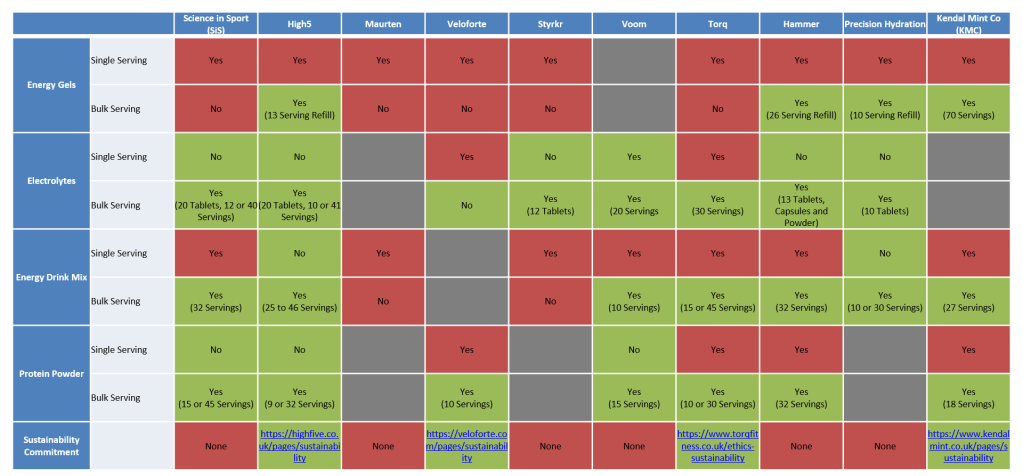
My thoughts / observations on this;
- Maurten could be considered the ‘worst offender’, none of the products they sell can be bought in bulk by the consumer – everything is single serve and there are no clear indications on their website about their packaging or any sustainability commitments.
- Veloforte is similar, largely all their products are single serve as default, barring Protein which is available in a smaller sized bulk packet. Veloforte have a dedicated sustainability page and note they are looking at alternative package and offer recycling options. While this is more than some, it does feel a little bit at odds with their marketing messages around being a ‘natural’ choice.
- Torq offer both bulk and single serve options, but do have the most comprehensive and considered sustainability section on their website. This is well worth a read if you want a more detailed review of the packaging options and their own considerations.
- Four Brands – High5, KMC, Hammer and PH&F – all offer bulk serving gels and dedicated flasks to replace single serve gels which is great – so why is it only them leading the way on this?
I do appreciate this is a rather narrow and simplified view of a large and complex problem, considering factors like local recycling capabilities, production methods, and emerging technologies. It isn’t just limited to nutrition, consider shoes, clothes, bottles and the list and the impacts go on. Then their athlete choice and preference, as someone who suffers from IBS a lot of my choices are driven by what doesn’t aggravate my stomach – so I know fuel sources can be as individual as shoes and bib shorts, meaning the environmental considerations come, at best, second.
That said, I don’t see why big brands cannot significantly reduce or eliminate the packaging they create in the first place.
In my opinion single serving options should never be the default or only option for consumers. While single serve portions have a place in certain circumstances, most athletes in their day to day training could work with refills, bulk bags, and tubs.
Wrap Up
Eliminating single-use packaging and plastic is key, followed by reducing and recycling. It’s not enough to continue with business as usual and rely on the claim that “our packaging can be recycled.” This leads consumers to continue consuming at high levels with a clean conscience. For example, High5 and Veloforte allow you to post your wrappers back, but my experience in the waste and recycling industry suggests that the majority of people won’t do this. Recycling has to be ridiculously easy for people to bother.
The fact is, waste needs to be prevented in the first place. The sports nutrition industry needs to lead and influence this shift, genuinely turning the dial in this space. I wonder whether it’s just easier not to.
Why not ask your preferred brand what they are doing and the sustainable commitments have or are prepared to make.
 Guy Stapleford Ultra